
Cementitious or Polymer-Cement Coatings
Evaluate for compatible concrete and cement screed. Verify the required movement and exposure properties.
Build a continuous waterproof layer behind finishes. In bathrooms, showers and other wet rooms, focus on the connection to the drain, floor-to-wall transitions, pipe penetrations and changes in substrate. Choose the coating or sheet as part of a compatible tiled assembly.
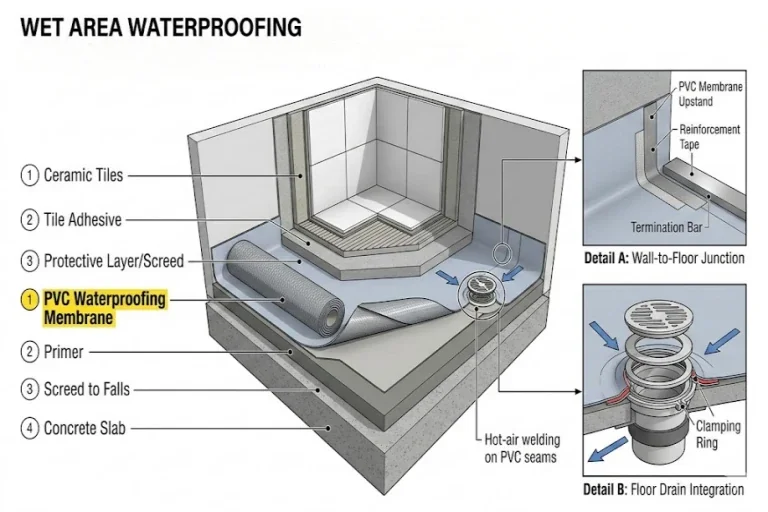
This example is listed from finish to substrate. Follow the selected system’s required floor falls, coverage, reinforcement and testing provisions.
Confirm adhesion to the substrate and tile-setting system. Exposure in an indoor shower, balcony and commercial wash area can differ substantially.
Evaluate for compatible concrete and cement screed. Verify the required movement and exposure properties.
Use a grade documented for the expected wet exposure and tile assembly. Confirm primer, coat thickness, cure and finish compatibility.
Consider a documented bonded sheet system for specified wet areas. Check laps, seams and accessories at the drain and corners.
Coordinate outlet type and membrane connection with the floor build-up and falls.
Review upstands, pipe collars, shower transitions and changes in substrate.
Check required coverage or thickness, cure and any flood test before covering, following the applicable specification.
The wet-area design should specify the waterproofing assembly beneath or behind the finishes, including the drain connection and penetrations.
Use the product’s required coverage and cured film thickness. Confirm coat sequence, reinforcement and curing conditions for the selected system.
Ask for evidence for the exact bonded waterproof membrane in the tile assembly. Confirm local requirements and the drain and tile-setting system details.
Include Bathroom & Wet Area Waterproofing in your project details and send the information below.