
Landfill Side Slopes and Covers
Identify the layers above and below the liner, then confirm the interface testing requirements and the connection to the base liner.
Oseaguard textured HDPE geomembrane has a roughened surface on one or both sides. It is specified where the liner needs greater interface shear resistance against soil, geotextile or a drainage layer. Use the actual layer combination and project loads to select which face or faces need texture.
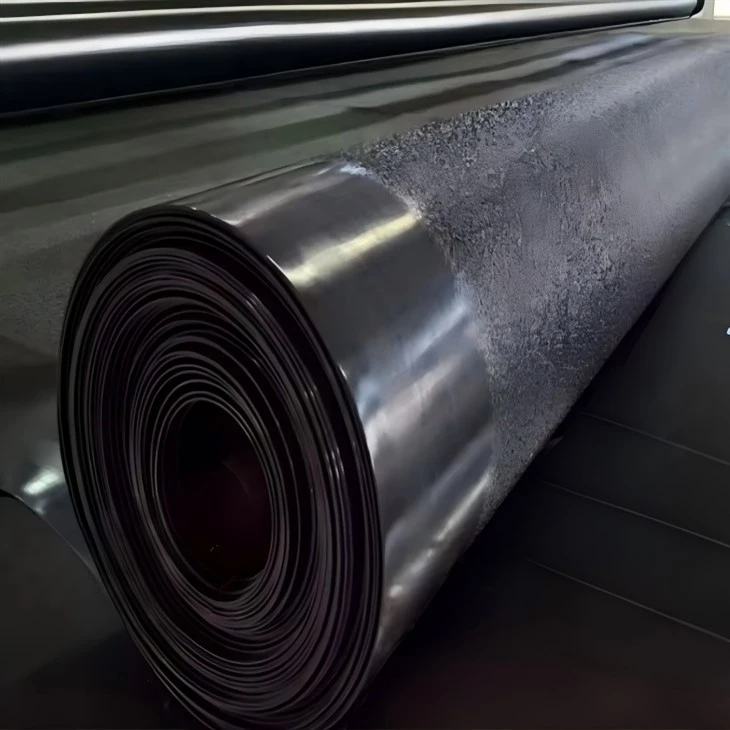
Mark the textured face on the liner section. Identify the materials on each side and give the normal stresses specified for interface testing.
| Property | Product reference |
|---|---|
| Surface options | Single-sided or double-sided texture |
| Nominal core thickness | Confirm thickness of the HDPE core separately from texture height |
| Texture declaration | Specify the tested face, asperity height and the corresponding product data |
| Roll and seam details | Confirm width, length and welding edge configuration for the grade |
| Field joining | Hot-wedge or extrusion welding as appropriate to the detail and quality plan |
| Design test | Site-specific direct shear data for the actual material pair and specified conditions |
ASTM D5321/D5321M can be specified for appropriate soil–geosynthetic and geosynthetic–geosynthetic interfaces. The design engineer selects the test conditions and acceptance criteria.
A single-sided texture can target one interface, while double-sided texture should be evaluated when both interfaces matter. Include the cover, geotextile, drainage product and subgrade in the layer schedule. A generic friction value is not a substitute for testing the materials and loading conditions used in the design.
Slope stability depends on the full system, including cover materials, drainage and anchorage.
Identify the layers above and below the liner, then confirm the interface testing requirements and the connection to the base liner.
Submit side-slope sections and water-level conditions. Review proposed covers, geotextile and drainage interfaces.
Provide the project loads, service chemistry and drainage layers. Request the grade and site-specific testing required by the designer.
Evaluate double-sided texture when the design depends on increased shear resistance at both faces. Test each relevant interface with the adjacent material used in the project.
Core thickness refers to the base sheet thickness. Asperity height describes the raised texture. Request both values if the specification calls for them.
They can be part of the same engineered lining system. Confirm compatible grade, welding edge details and the transition seam inspection plan.
Select HDPE geomembrane in the form and include Textured HDPE Geomembrane in your project details. Send the following information with your request.